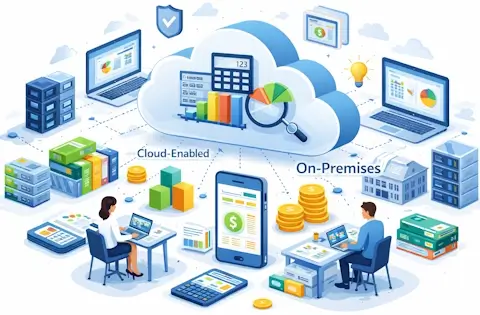
What is Accounting: Meaning, Types & Why It Matters
What Is Accounting?
Accounting records, classifies, summarises, and reports financial transactions. Businesses rely on it to track income, expenses, assets, liabilities, and profitability. Without it, an organisation cannot measure performance, meet its tax obligations, or make informed decisions.
In business, economic activity happens as transactions — also called account transactions — and a company records these in the books of accounts. Ultimately, accounting captures every one of them and turns raw numbers into a clear picture of how the business is doing.
Key Takeaways
- Accounting records, classifies, summarises, and reports a business’s financial transactions.
- It answers three questions for any owner: What do I own? What do I owe? Am I making a profit?
- At its core sits one equation — Assets = Liabilities + Equity — recorded through double-entry bookkeeping.
- The main branches are financial, management, cost, and tax accounting.
- In India, meanwhile, accounting must also meet GST, TDS, and — for larger companies — Indian Accounting Standards (Ind AS) rules.
Table of Contents
- What Is Accounting
- The Basic Accounting Equation
- The Golden Rules of Accounting
- Accounting vs Bookkeeping
- A Worked Example
- Why Accounting Is Important
- Types of Accounting
- The Accounting Cycle
- The Financial Statements
- Core Accounting Principles
- Accounting Standards (GAAP, IFRS, Ind AS)
- Accounting in India: GST & TDS
- Accounting Terminology
- Ways to Manage Accounting
- A Short History of Accounting
- FAQs
The Basic Accounting Equation
Assets = Liabilities + Equity
In plain terms, this equation tells us: What you have = What you owe + What you truly own.
- Assets — everything the business owns.
- Liabilities — everything the business owes to others.
- Equity — the owner’s share in the business, or what remains after paying all debts.
The Golden Rules of Accounting
Every transaction follows double entry, and three simple rules decide which account to debit or credit. First, though, you group accounts into three types:
1. Personal Accounts (individuals, firms, companies) — Debit the receiver, credit the giver. For example, when you pay ₹5,000 to a supplier, Ramesh, you debit Ramesh’s account because he receives the money.
2. Real Accounts (assets such as cash, machinery, buildings, patents) — Debit what comes in, credit what goes out. For instance, when you buy machinery for cash, machinery comes in (debit) while cash goes out (credit).
3. Nominal Accounts (incomes, expenses, gains, losses) — Debit all expenses and losses, credit all incomes and gains. So when you pay ₹2,000 rent, you debit rent as an expense and credit cash.
Applied consistently, these three rules keep the accounting equation in balance on every single entry.
Accounting vs Bookkeeping
Many people use the terms accounting and bookkeeping interchangeably. However, they are not the same.
Bookkeeping records daily financial transactions such as sales, purchases, receipts, and payments. In other words, it keeps your financial records accurate and up to date.
Accounting, by contrast, is a broader process that uses those bookkeeping records to prepare financial statements, analyse performance, and help owners make better decisions.
Put simply, bookkeeping records financial information, while accounting helps you understand what that information means.
A Worked Example (With Journal Entries)
Suppose a shop sells goods worth ₹10,000 for cash in a day and buys new stock worth ₹4,000 for cash. First, a bookkeeper records the two transactions; then an accountant uses them to calculate profit and check the health of the business. Here is what the actual double-entry records look like:
Transaction 1 — Cash sale of ₹10,000
| Account | Debit (₹) | Credit (₹) |
|---|---|---|
| Cash A/c | 10,000 | |
| Sales A/c | 10,000 |
Cash comes in as an asset, so you debit it; sales is income, so you credit it.
Transaction 2 — Cash purchase of ₹4,000
| Account | Debit (₹) | Credit (₹) |
|---|---|---|
| Purchases A/c | 4,000 | |
| Cash A/c | 4,000 |
Purchases is an expense, so you debit it; cash goes out, so you credit it.
From these records, the accountant sees a gross profit of roughly ₹6,000 for the day (₹10,000 sales − ₹4,000 cost of goods). As a result, he can prepare reports, check the business’s financial health, and guide the owner’s future decisions. That interpretation — turning raw entries into decisions — is exactly what separates accounting from bookkeeping.
Why Accounting Is Important for Your Business
If you run a business, you already sense that accounting is its backbone.
Without proper accounts, you cannot look after your customers and vendors, nor can you know your financial position at any given moment. As a result, even a simple request about receipts or payments becomes hard to answer.
Therefore accounts play a major role in managing, growing, and protecting the integrity of a business. Beyond recording transactions, they also help you understand your financial performance, meet tax laws, and plan for the year ahead.
Ignore your accounts, and the business quickly faces trouble — mismanaged income and expenses, legal problems, and lost opportunities.
Types of Accounting
Corporate finance uses several types of accounting, and each one serves a different purpose and industry. Here are the ones businesses use most often:
1. Financial Accounting
Financial accounting systematically records, summarises, and reports financial information, with a strong emphasis on external reporting. In this way, it ensures transparency and accountability to stakeholders.
Importantly, financial accounting follows Generally Accepted Accounting Principles (GAAP) or International Financial Reporting Standards (IFRS). These frameworks keep transactions consistent across organisations, which promotes comparability and reliability.
Under financial accounting, a business prepares three main statements: the balance sheet, the income statement, and the cash flow statement. The balance sheet lists assets, liabilities, and equity at a specific point in time. Meanwhile, the income statement reports revenues, expenses, and profit or loss over a period, and the cash flow statement tracks the cash moving in and out. To handle all of this, many owners pick from the best accounting software in India.
2. Management Accounting
Unlike financial accounting, management accounting does not follow GAAP, so a business can prepare it using whatever methods suit its users. Typically, this means specialised reports built for internal stakeholders.
Because it guides managers and executives, management accounting focuses on planning, control, performance management, cost analysis, decision support, resource allocation, and risk management. Common reports include variance analysis, performance dashboards, and activity-based costing.
3. Cost Accounting
Cost accounting identifies every cost tied to a product or service, then classifies those costs as direct, indirect, fixed, or variable. Next, it measures each category and analyses where the business can save.
Management uses these insights for budgeting, cost control, and healthier margins. Unlike financial accounting, which serves external readers, cost accounting supports internal decisions and does not follow GAAP. Common methods include standard costing, activity-based costing, lean accounting, and marginal costing.
4. Tax Accounting
Tax accounting focuses on preparing and managing taxes, tax laws, and tax regulations. Consequently, it deals far more with compliance than financial accounting does.
Its primary goal is simple: keep the business compliant with the tax laws of its jurisdiction while legally optimising its tax liability. In practice, tax accounting covers tax planning, compliance, record keeping, reporting, and audits, and it also tracks changing tax laws, credits, and year-end activities.
Types of Accounting at a Glance
| Type | Main Purpose | Primary Audience | Follows Standards? | Typical Reports |
|---|---|---|---|---|
| Financial Accounting | Report overall financial position | External (investors, lenders, regulators) | Yes — GAAP / IFRS / Ind AS | Balance sheet, P&L, cash flow |
| Management Accounting | Support internal decisions | Internal (managers, executives) | No | Budgets, forecasts, dashboards, variance analysis |
| Cost Accounting | Track and control production costs | Internal (operations, management) | No | Cost sheets, costing reports, margin analysis |
| Tax Accounting | Ensure tax compliance & planning | Tax authorities, management | Follows tax law (e.g., Income Tax Act, GST) | Tax returns, computations, filings |
The Accounting Cycle: 8 Steps
The accounting cycle is the set of steps a business repeats each period to turn raw transactions into finished financial statements. Fortunately, modern software automates most of it.
- Identify transactions — capture every financial event, from sales to receipts, with source documents.
- Record journal entries — enter each transaction in the journal using double entry.
- Post to the ledger — move entries from the journal into individual ledger accounts.
- Prepare an unadjusted trial balance — list all ledger balances to confirm total debits equal total credits.
- Make adjusting entries — add accruals, prepayments, depreciation, and other period-end adjustments.
- Prepare an adjusted trial balance — re-check that the books still balance afterwards.
- Prepare financial statements — produce the income statement, balance sheet, and cash flow statement.
- Close the books — close temporary accounts to retained earnings and carry balances forward.
The Three Core Financial Statements
Accounting produces three primary statements, and together they give a complete picture of a business’s financial health.
1. The Balance Sheet — a snapshot at a single moment. It shows what the business owns (assets), what it owes (liabilities), and the owner’s share (equity). Essentially, this is the accounting equation in report form.
2. The Income Statement (Profit & Loss) — covers a period such as a month or year. Here, revenue meets expenses, and the result reveals whether the business actually makes money.
3. The Cash Flow Statement — also covers a period. It follows the cash moving in and out across operating, investing, and financing activities. Notably, a business can look profitable on paper yet still run out of cash, and this statement catches that early.
Core Accounting Principles & Concepts
To keep statements consistent and comparable, accounting follows a set of established concepts:
- Business Entity — treat the business as separate from its owner.
- Money Measurement — record only what you can express in money.
- Going Concern — assume the business will keep operating for the foreseeable future.
- Accrual — record revenue and expenses when you earn or incur them, not when cash moves.
- Matching — match expenses to the revenue they help generate in the same period.
- Consistency — use the same methods period after period so results stay comparable.
- Prudence (Conservatism) — anticipate losses, never profits; never overstate income or assets.
- Materiality — disclose significant information, and simplify trivial items.
- Dual Aspect — every transaction hits two accounts, which keeps the equation balanced.
Accounting Standards: GAAP, IFRS & Ind AS
Standards make financial statements reliable and comparable across companies. However, the framework you follow depends on where the business operates:
GAAP (Generally Accepted Accounting Principles) — the United States standard, which the FASB maintains.
IFRS (International Financial Reporting Standards) — used across 140+ countries and issued by the IASB. Because it is principles-based, IFRS aims for global comparability.
Ind AS (Indian Accounting Standards) — India’s standards. The Ministry of Corporate Affairs (MCA) notifies them, and the ICAI’s Accounting Standards Board formulates them. Broadly, Ind AS converge with IFRS rather than copy it, keeping certain India-specific “carve-outs.” They apply to all listed companies and to unlisted companies with a net worth of ₹250 crore or more, and the MCA rolled them out in phases from 1 April 2016. Smaller Indian businesses, meanwhile, still follow the older Accounting Standards (AS) from the ICAI.
Accounting in India: GST, TDS & Compliance
For Indian businesses, accounting is not only about profit and loss; instead, it ties directly to statutory compliance.
GST (Goods and Services Tax) — a single indirect tax on goods and services, with common slabs of 5%, 12%, 18%, and 28%. Businesses record GST on sales (output tax) and purchases (input tax credit), then file returns such as GSTR-1 and GSTR-3B. To speed this up, you can use a free GST invoice generator and GST calculator.
TDS (Tax Deducted at Source) — under the Income Tax Act, businesses deduct tax on certain payments, such as salaries, rent, and professional fees, and then deposit it with the government and file TDS returns. Naturally, you must track every one of these deductions in the books.
Statutory books — Indian law requires companies to keep proper books of accounts under the Companies Act, 2013, and the Income Tax Act. Depending on size, a Chartered Accountant may also need to audit those accounts.
Because of this compliance layer, many Indian small businesses move early to GST-ready accounting software rather than manual books.
Note: GST rates and TDS thresholds change from time to time, so always confirm current figures with a qualified CA or the official GST and Income Tax portals.
Different Terminologies in Business Accounting
Accounting terminology covers the terms used across accounts and finance. Naturally, the most useful ones appear often and help you read a business’s financial statements. Therefore it pays to understand terms such as these:
- Assets: anything of value the business owns, such as cash, inventory, and property.
- Liabilities: debts the business owes, such as accounts payable and loans.
- Equity: the owner’s investment plus retained earnings.
- Income: the money the business earns from operations.
- Expenses: the costs the business incurs to generate income.
- Profit: the difference between income and expenses.
- Loss: the opposite of profit, when expenses exceed income.
- Revenue: another term for income.
- Depreciation: spreading the cost of a long-term asset over its useful life.
- Accounts Receivable: money customers owe the business for credit sales.
- Accounts Payable: money the business owes suppliers for credit purchases.
- Cost of Goods Sold: the direct cost of producing what the business sells.
- Gross Profit: revenue minus cost of goods sold.
- Operating Expenses: running costs such as salaries, rent, and utilities.
- Net Income: gross profit minus operating expenses.
- Accounting Period: the span a set of statements covers, such as a month or year.
Accounting Terms That Business Owners Should Know
- Trial Balance: a list of every general-ledger account and its balance.
- P&L Statement: a summary of revenue, expenses, and net result over a period.
- Balance Sheet: a view of assets, liabilities, and equity at a point in time.
- Income Statement: a record of revenues, expenses, and profits over a period.
- Accrual Accounting: recognising revenue and expenses when earned or incurred, whatever the cash timing.
- Double Entry System: each transaction affects at least two accounts, so debits equal credits.
- Cash Accounting: recording revenue and expenses only when cash changes hands.
- Cash Flow Statement: a record of cash inflows and outflows over a period.
- Chart of Accounts: a full list of the accounts a business uses.
- General Ledger: the master book of all financial transactions.
- Closing Entries: period-end entries that clear the temporary accounts.
- Posting: moving information from the journal to the ledger.
- Amortisation: gradually writing down an intangible asset’s value.
- Auditing: checking financial records for accuracy and completeness.
- Accounting Standards: the rules that govern how a business prepares statements.
Different Ways to Manage Accounting for Your Business
How you manage accounting depends on the size, complexity, industry, and goals of your business. With that in mind, here are the main approaches:
1. Do Manual Accounts
Many of us start here. You might keep traditional ledger books — handwritten records that work, yet run slow. From there, most people move to spreadsheets like Microsoft Excel for records and basic statements. Spreadsheets stay flexible, but beware: one broken formula can throw off your whole month.
2. Keep In-House Accountants or Bookkeepers
As you grow faster, you might need someone full-time. An in-house accountant handles your transactions and reporting, and sits right there whenever a question comes up.
3. Use a Hybrid Approach
Better still, you do not have to pick just one option. Many businesses pair in-house staff with strong software, which blends hands-on control with modern flexibility.
4. Develop Custom Software (If Required)
Sometimes off-the-shelf simply will not fit. When your processes are truly unique, custom software becomes an option. It costs more, yet it matches your requirements exactly.
5. Try Software That Uses AI in Accounting
This one saves brainpower rather than replacing people. AI in accounting takes over boring data entry, so you can focus on interpreting the numbers and advising on strategy.
6. Collaborate With Tax Professionals
Taxes are their own beast. Working with CPAs and CAs keeps you compliant, and these professionals often find the strategies that save you money at tax time. If you partner with a firm, the right accounting software for CA firms makes that collaboration far easier.
7. Freelance Accountants and Virtual CFOs
Perhaps you need high-level advice but cannot justify a full-time executive salary. In that case, a Virtual CFO or freelance accountant gives you strategic financial guidance without the overhead.
Ultimately, the right choice comes down to your size, budget, complexity, and goals. For example, small businesses often find online accounting apps like QuickBooks Online enough, whereas larger enterprises lean on ERP systems or dedicated teams. So weigh your needs and resources before you settle on an approach.
A Short History of Accounting
Accounting ranks among the oldest business practices in the world. In fact, the earliest records reach back to ancient Mesopotamia, where merchants tracked goods on clay tablets. The system we use today, however, grew from double-entry bookkeeping, which the Italian mathematician Luca Pacioli documented in 1494 in his book Summa de Arithmetica. Although people call him the “father of accounting,” Pacioli did not invent double entry — Venetian merchants already used it — yet he was the first to write it down systematically. Remarkably, that same debit-and-credit logic still underpins every accounting system today.
Frequently Asked Questions (FAQs)
What is the purpose of accounting?
Accounting exists to record, analyse, and communicate financial information about a person’s or organisation’s economic activity. Specifically, it measures transactions, informs stakeholders, guides managers’ decisions, supports compliance, and helps detect fraud.
How does bookkeeping differ from accounting?
Bookkeepers record transactions, while accountants interpret them. In short, bookkeeping captures the raw financial details, whereas accounting summarises, analyses, and explains the bigger financial picture.
What are the three golden rules of accounting?
For personal accounts, debit the receiver and credit the giver.
For real accounts, debit what comes in and credit what goes out and for nominal accounts, debit all expenses and losses and credit all incomes and gains.
What is an accounting equation?
The accounting equation, also called the balance sheet equation, reads Assets = Liabilities + Equity. Because it always balances, total assets must equal total liabilities plus total equity.
What are accounting ratios?
Accounting ratios, also called financial ratios, measure a company’s performance and position.
For example, common ones include the current ratio, quick ratio, debt-to-equity ratio, return on assets, and return on equity, alongside liquidity, solvency, and profitability ratios.
What is an accounting cycle?
The accounting cycle is the sequence a business follows to record, classify, and analyse transactions and then prepare statements. Typically, it runs from identifying and recording transactions, through posting, the trial balance, adjusting entries, and statements, to closing and starting the next period.
What are the major accounting software platforms?
Globally, popular platforms include QuickBooks, Xero, Zoho Books, Wave, and FreshBooks, while Tally, Vyapar, Busy, and Marg lead in India.
For a detailed comparison, see our roundup of the best accounting software in India.
What are accounting ethics?
Accounting ethics are the principles accountants must follow, which bodies such as the AICPA and ICAEW actively promote. Above all, they rest on honesty, integrity, confidentiality, due care, and professional behaviour.
What skills are required for accounting?
Accountants need maths, analytical, and problem-solving skills, plus solid spreadsheet and software knowledge. Naturally, the exact mix varies by job role and industry.
What is the future of accounting?
AI and automation are reshaping accounting fast. Consequently, accountants must adapt, learn AI-driven systems, and pick up data analytics and visualisation.
Looking ahead, the key trends include wider AI use, growing big data, and the rising importance of ethics.
Related Resources:
5 Best Open Source Accounting Software for Small Business 2026
What is an Accounting System? Accounting Components, Types and Examples
Top 13 Financial Accounting Software for Indian Businesses 2026
8 Best Cloud-Based Accounting Packages for Indian SMEs (2026)
Top Free Accounting Software Options for India GST
The 5 Best AI Accounting Software for Small Business
The CAs Tech Stack: 5 Best Accounting Software for CA Firms in India 2026
Top 5 Cloud-Enabled Accounting Software in India (Hybrid Tools)