10 Best Cloud ERP Software In India For SMEs & SMBs 2026
Imagine it is 6 PM on a Friday. You are just about to leave your factory or office to head home for the weekend. Suddenly your production manager runs in and says we are out of raw material for the big order due on Monday. Your sales guy is calling to ask why the invoice for Mr. Sharma hasn’t been generated yet. And your accountant? He is buried under a pile of papers looking for a GST receipt from three months ago.
Does this sound familiar?
If you are running a Small or Medium Enterprise (SME) in India finding yourself trapped in this daily chaos is painful. You are working in your business rather than on your business.
This is where a cloud erp comes in to save the day.
As a consultant who has spent years watching Indian businesses struggle with spreadsheets and disconnected software I have written this guide specifically for you. We are going to look at the 10 best options available in India for 2026. I have kept the language simple because I believe technology should solve headaches not create new ones.
What Actually is Cloud ERP Software?
Let us keep this super simple. Imagine a human body. You have eyes, hands, legs, and a heart. But without a brain none of these parts know what the other is doing.
In your business your sales team, your warehouse, your factory floor, and your accounts department are the body parts. An ERP (Enterprise Resource Planning) software is the brain. It connects everything.
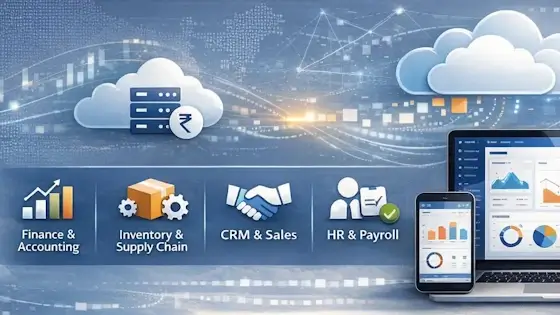
When you add “Cloud” to it it simply means this brain lives on the internet. You do not need to buy expensive servers or hire an IT guy to sit in a dark room and maintain it. You just log in from your laptop or mobile whether you are at the office, at home, or traveling.
Why Indian SMEs Are Moving to the Cloud?
The Indian market is unique. We need things to be cost effective but we also need them to be robust enough to handle complex GST compliance and changing market trends.
Here is why moving to manufacturing cloud erp software or general business ERP is the right move for you:
- Lower Upfront Cost: You pay a monthly subscription instead of buying a massive license fee upfront.
- Access Anywhere: You can approve a Purchase Order from your phone while stuck in traffic.
- Data Security: Believe it or not your data is safer on a cloud server like AWS or Azure than it is on a hard drive in your office that could get stolen or crash.
Now let us dive into the list. I have researched these deeply looking at what actual users in India are saying for 2026.
10 Best Cloud ERP Software in India for SMEs, SMBs, & Manufacturing Units.
1. Oracle NetSuite
If you are an SME that has plans to become a large enterprise very fast NetSuite is often considered the gold standard. It is a true cloud pioneer.
Why it is good for you:
NetSuite is like buying a luxury car that is built to handle rough roads. It covers everything from financials to CRM and ecommerce. For a manufacturing business it offers very strong supply chain visibility.
The Consultant’s Take:
I often recommend this to my clients who have a slightly higher budget and need a system that will not break when they expand to multiple cities or countries. It handles multiple currencies and tax laws very well.
Key Features:
- Real time financial reporting
- Advanced inventory management
- Built in business intelligence
Best For: Mid sized businesses growing rapidly.
Check them out here: Oracle NetSuite
2. SAP Business One
You have probably heard the name SAP and thought it is only for massive companies like Reliance or Tata. But SAP Business One (often called SAP B1) is their specific offering for SMEs.
Why it is good for you:
It is incredibly stable. In the world of erp software india SAP B1 has a massive network of partners. This means you can easily find local support teams in cities like Mumbai, Delhi, or Bangalore who can come to your office and help you set it up.
The Consultant’s Take:
If you run a manufacturing unit this is a solid choice. It handles “Material Requirements Planning” or MRP software cloud needs beautifully. It tells you exactly what to buy and when so your machines never stop.
Key Features:
- Excellent production planning
- Strong integration with Microsoft Outlook
- Detailed sales and opportunity management
Best For: Manufacturing and trading SMEs who want a global brand.
Check them out here: SAP Business One
3. Microsoft Dynamics 365 Business Central
If your office lives and breathes on Microsoft Excel and Outlook this software will feel like home.
Why it is good for you:
The interface looks just like other Microsoft products. This is a huge advantage because your staff will not need months of training to learn how to use it. It is very intuitive.
The Consultant’s Take:
I love how flexible this is. You can start with just the finance module and add the warehousing or manufacturing pieces later. It connects seamlessly with Power BI which lets you see beautiful charts of your sales data.
Key Features:
- Seamless integration with Office 365
- Project management tools
- Smart forecasting using AI
Best For: Companies already invested in the Microsoft ecosystem.
Check them out here: Microsoft Dynamics 365
4. Zoho ERP (Zoho One)
Zoho is the pride of Indian software development. Based out of Chennai they have taken the world by storm. Zoho does not sell a single “ERP” product but rather a suite called “Zoho One” which acts as a completely operating system for business.
Why it is good for you:
It is incredibly affordable. For an Indian SME sensitive to price Zoho offers the best bang for your buck. You get access to over 40+ apps including CRM, Books (Finance), Inventory, and People (HR).
The Consultant’s Take:
Zoho is like a Lego set. You can build exactly what you need. If you are a small manufacturer you can use Zoho Inventory coupled with Zoho Books to create a very efficient flow without spending lakhs of rupees.
Key Features:
- GST compliant invoicing built in
- Custom app creation using Zoho Creator
- Mobile apps for almost every function
Best For: Small businesses and startups looking for affordability and flexibility.
Check them out here: Zoho One
5. Tally Prime (With Remote Access)
Okay I know what you are thinking. “Tally is just accounting software right?”
Technically yes. But in India Tally is the heartbeat of 80 percent of SMEs. With Tally Prime they have introduced connected services that allow remote access and better data synchronization effectively functioning as a lightweight best erp software in india for smaller setups.
Why it is good for you:
Your accountant already knows how to use it. You do not need to hire anyone new. It is GST ready and works flawlessly for compliance.
The Consultant’s Take:
While it lacks deep manufacturing features like complex routing or capacity planning, for a trading business or a simple assembly unit Tally Prime is often enough. Do not overcomplicate things if you do not have to.
Key Features:
- Unbeatable speed in accounting
- Remote access capabilities
- E-Way bill generation integration
Best For: Small businesses where accounting and compliance are the main priority.
Check them out here: Tally Solutions
6. TranZact
This is a special mention because TranZact is built specifically for Indian SME manufacturers.
Why it is good for you:
Most ERPs are built for finance first and factory second. TranZact is the opposite. It is built to digitize your entire production process from inquiry to dispatch. They even have a “freemium” model where you can start for free.
The Consultant’s Take:
If you are looking for dedicated manufacturing erp software that understands Indian problems like “job work” and “multi level BOMs” (Bill of Materials) this is a fantastic tool. It is very user friendly.
Key Features:
- Visual production tracking
- Integration with Tally for accounting
- Purchase and inventory control
Best For: Indian manufacturers who want to digitize production without high costs.
Check them out here: TranZact
7. Deskera
Deskera is another strong player that has focused heavily on the Asian market including India.
Why it is good for you:
Deskera is known for being an “All in One” platform. It combines Accounting, CRM, and HR into one easy dashboard. It is visually very appealing and simple to navigate.
The Consultant’s Take:
I find Deskera great for companies that have a sales team on the field. Their mobile app is excellent. A sales person can scan a business card and create a quote in seconds.
Key Features:
- Strong HR and Payroll module compliant with Indian laws
- Built in CRM
- easy to use MRP capabilities
Best For: SMEs that need HR and Accounting tightly integrated.
Check them out here: Deskera
8. Focus Softnet (Focus 9)
Focus Softnet has been in the Indian market for decades. This is their cloud based ERP offering.
Why it is good for you:
It is highly customizable. If your business has a very unique way of working that does not fit into standard software Focus 9 can be molded to fit you.
The Consultant’s Take:
They have a strong local presence in many Indian cities. Their AI integration is getting better allowing for features like a voice interface where you can ask the system for reports.
Key Features:
- AI driven analytics
- Scalable architecture
- Strong retail and POS integration capabilities
Best For: Retail and distribution businesses.
Check them out here: Focus Softnet
9. Acumatica
Acumatica is arguably the fastest growing cloud ERP globally and it is gaining traction in India through partners.
Why it is good for you:
They have a unique pricing model. They charge based on resources used not by the number of users. This means you can give login access to your entire staff without your bill going up.
The Consultant’s Take:
This is true cloud erp technology. It was born in the cloud not adapted from an old system. It is very modern and connects easily with other software.
Key Features:
- Consumption based pricing
- Industry specific editions (Construction, Manufacturing, etc)
- User friendly interface
Best For: Growing companies that want to involve all employees in the system.
Check them out here: Acumatica
10. Marg ERP 9+ (Marg Books)
Marg is a giant in the Indian Pharma and Retail sectors. While they are known for on premise software their cloud initiatives are strong.
Why it is good for you:
If you are in the pharmaceutical industry or run a retail chain Marg is the default choice. It has over 2.5 lakh chemist shops using it.
The Consultant’s Take:
For specific industries generic ERPs fail. Marg understands expiry management, batch tracking, and prescription management better than anyone else in India.
Key Features:
- Deep inventory capabilities for Pharma
- Fast billing counter features
- GST filing integrated
Best For: Pharma, FMCG, and Retail businesses.
Check them out here: Marg ERP
Comparison Table: A Quick Glance
To help you decide I have put together this simple table. This helps you compare apples to apples.
| ERP Software | Best Suited For | Key Strength | Pricing Model |
|---|---|---|---|
| Oracle NetSuite | Mid to Large SMEs | Scalability & Global features | Per User / Subscription |
| SAP Business One | Manufacturing & Trading | Stability & Industry Standards | Per User |
| Microsoft Dynamics | Microsoft Users | Office 365 Integration | Per User |
| Zoho One | Small Business / Startup | Affordability & Customization | Per User (Very Low) |
| Tally Prime | Small Trading / Service | Accounting Simplicity | License |
| TranZact | Manufacturers | Production Visibility | Freemium / Tiered |
| Deskera | General SMEs | All-in-One (HR + Accounts) | Per User |
| Focus 9 | Retail & Distribution | Customization | Subscription |
| Acumatica | Growing Teams | Unlimited Users | Resource Based |
| Marg ERP | Pharma & Retail | Industry Specific Features | License / Subscription |
How to Choose the Right One? (A Consultant’s Guide)
Choosing software is like choosing a business partner. You are going to be with them for a long time so you better choose wisely. Here are three simple steps to follow.
1. Define Your Pain Point
Do not buy software just because it looks cool. Ask yourself what hurts the most right now.
Is it that you don’t know how much stock you have? Then look for strong Inventory/MRP.
Is it that you can’t track your sales team? Then look for strong CRM.
Is it just GST filing? Then stick to Tally or Zoho Books.
2. Check the “Indian-ness”
Does the software handle TDS automatically? Does it generate E-Way bills? Can it handle the complex GST tiered structures? International software is great but if it cannot handle Indian taxes you will end up doing double work.
3. Ask for a “Day in the Life” Demo
Do not just watch their standard powerpoint presentation. Ask the sales guy to simulate a day in your business. Tell him “Show me how to create a job work challan” or “Show me what happens if a customer returns goods.” If the software takes 20 clicks to do that it is too complicated.
In the future we will likely see more AI ERP software features embedded in these tools which will help you predict sales before they happen but for now focus on getting the basics right.
Frequently Asked Questions (FAQ)
1: Is cloud ERP safe for my business financial data?
Yes. In fact top cloud providers invest millions in security which is far more than an average SME can spend on securing their local office server. They use encryption and regular backups to keep data safe.
2: Do I need a fast internet connection for Cloud ERP?
You need a stable connection but it does not have to be lightning fast. 4G mobile data or standard broadband is usually sufficient for most cloud ERPs in India today.
3: How much does Cloud ERP cost in India?
It varies wildly. Solutions like TranZact or Zoho can start from free or a few thousand rupees per month while SAP or NetSuite can cost significantly more depending on the number of users and complexity.
4: Can I keep using Tally for accounts if I buy another ERP?
Yes. Many specialized ERPs (like TranZact or CRM tools) offer integration with Tally. This allows your operations team to use the new software while your accountant continues using Tally.
5: What is the difference between ERP and MRP?
ERP (Enterprise Resource Planning) covers the whole business including HR, Sales, and Finance. MRP (Material Requirements Planning) is a subset specifically for the factory floor dealing with raw materials and production scheduling.
Conclusion
Moving to a cloud erp is a big step. I know it feels scary to change how you work especially if you have been using manual books or Excel for years. But the businesses that will survive in 2026 and beyond are the ones that are agile and data driven.
My advice to you is to pick two or three from the list above. Call them up. Ask for a free trial. Let your accountant and your production manager play with the software.
Remember the goal is to make your life easier so you can go home on time on Fridays.
Good luck with your digitization journey!
Related Resources:
Best ERP Software for Discrete & Process Manufacturing Industries