8 Best Cloud Based Accounting Software in India (2026 Updated)
Choosing cloud accounting software in India means checking how your team will manage billing, bank reconciliation, GST work and access to the accounts and what the required plan will cost.
Indian businesses should look for GST compliance, e-invoicing support, inventory management, and reliable mobile access when choosing a platform.
Cloud access does not automatically include GST filing or e-invoice registration.
Check which functions the selected plan supports, whether additional services are required and which steps remain manual.
Your accountant can confirm the e-invoicing requirements that apply to your business.
The best cloud accounting software in India for most SMEs in 2026 is Zoho Books, followed by HostBooks for compliance-heavy businesses and RealBooks for multi-branch operations.
In this guide, we compare the best cloud-based accounting software for Indian SMEs, traders, freelancers, and manufacturers—based on features, pricing, ease of use, and real-world practicality.
Whether you run a small shop, a growing distribution business, or a service-based startup, this guide will help you choose the right tool for your workflow.
Quick Summary: The Best Online Accounting Software for Small Businesses
- Zoho Books – For overall cloud accounting software for Indian SMEs
- HostBooks – For GST, TDS, and compliance-heavy businesses
- RealBooks – For multi-branch and large-scale operations
- Reach – For end-to-end ERP and business automation
- Refrens – For freelancers, startups, and consultants
- ProfitBooks – For small business owners and beginners
- AlignBooks – For retailers and inventory-heavy businesses
- ZipBooks – For traders and distributors
Feature availability depends on the edition. Use the comparison below to check the purchasing details.
What is a cloud based accounting software?
Still deciding between cloud and desktop software? Our best accounting software in India comparison covers 13 products, including cloud and desktop options, with plan costs, features and limitations.
Cloud based accounting software or otherwise known as online accounting software is a type of software application that enables users to manage their finances anywhere they have access to the internet.
Businesses often use these software through a browser or an app.
Therefore your accountant can work from home, your owner can check sales from a phone, and your data is available on more than one device. Updates happen automatically, backups are handled by the vendor, and you do not need to depend on one office computer.
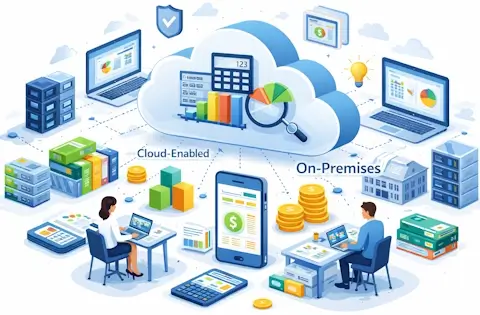
However some accounting software are not fully cloud native. They are installed on your computer and runs on desktop or mobile devices via cloud sync. For a buyer, this matters because cloud native tools usually feel smoother for remote work, while cloud hosted desktop tools often feel familiar to long time Tally users.
Here is a clear difference between cloud based, desktop based, and hybrid accounting models.
| Type | How it works | Best for | Main limitation |
|---|---|---|---|
| Cloud based | Runs on the internet, log in from browser or app | Businesses that want remote access and automatic updates | Needs stable internet |
| Desktop based | Installed on one computer or local network | Small offices with one fixed setup | Hard to access remotely |
| Hybrid or cloud hosted | Desktop style software accessed through cloud hosting | Businesses that want familiar workflows with remote access | Quality depends on the hosting provider |
Why Cloud Accounting Matters More in 2026
In 2026, small businesses in India are not buying accounting software only for billing. They want speed, compliance, visibility, and control.
If you are a wholesaler, you may be handling dozens or hundreds of invoices every month. And, if you are a small manufacturer, you may be tracking raw material, production, and finished stock. If you are a distributor, you may have multiple branches and warehouses. But, if you are a solo business owner, you may just want to send bills and see who still owes you money.
Cloud based accounting helps because everyone works on the same data. Your sales team, accounts team, and business owner do not need separate files. That alone saves a lot of confusion.
The other big reason is compliance. GST, e invoicing where applicable, e way bill support, bank reconciliation, and faster reporting are now basic expectations. In 2026, a good accounting tool should reduce manual work, not add more of it.
For example, if you run a corrugated box unit in Ludhiana and keep two godowns, you need to know how much paper is left, how many finished boxes are ready, and which customer still has pending dues. A cloud based tool can show that faster than a messy spreadsheet ever will.
What Features Should Online Accounting Software in India have in 2026?
For most Indian businesses, the useful features are not simply “cloud access.”
Check whether the plan supports the work your business actually performs: GST invoicing and reporting, e-invoicing where applicable, bank reconciliation, inventory, user permissions, branch or warehouse management, mobile access, data export and integrations.
Also distinguish between generating GST-compatible invoices, preparing return data, filing returns and registering e-invoices.
These are separate functions and may not all be included in the same subscription.
How This Comparison Was Prepared
This comparison draws on vendor product pages, pricing information and help documentation. It considers published accounting functions, GST workflows, inventory capabilities, user access and purchasing terms.
Recommendations reflect documented capabilities. They are not the results of hands-on testing of all eight products. Features may differ between editions, so confirm the subscription and any additional services needed for your business.
Quick comparison of the best cloud based accounting software in India 2026
| Software | Best For | Standout Strength | Check Before Buying |
|---|---|---|---|
| Zoho Books | SMEs wanting automation + GST ease | AI-powered automation, GSP integration, mobile-friendly, full GST suite | Edition required for warehouses, batch tracking and serial numbers |
| HostBooks | Growing businesses with compliance needs | ERP-like features (TDS, GST, e-Invoicing, Payroll), great for modern Indian SMBs | Included modules, setup costs and recurring charges |
| RealBooks | Auto dealers & multi-branch firms | Advanced multi-entity handling, strong MIS & BI, GST reporting | Users, branches and reporting included in the quoted plan |
| Reach | Businesses seeking end-to-end ERP | Ready-to-use business automation for 21 industries, inventory + CRM | Licence term, user allowance and included modules |
| Refrens | Freelancers, startups, consultants | Free plan, user-friendly invoicing, recurring billing, multi-currency support | Document limits and the plan needed for accounting and inventory |
| ProfitBooks | Small businesses & solopreneurs | Simple inventory + purchase/sales workflow, intuitive for non-accountants | Users and invoice allowance in the selected plan |
| AlignBooks | Retailers & service providers | Barcode tracking, Amazon/Shopify sync, strong inventory & POS features | Edition required for production, branches and integrations |
| Zipbooks | Traders & distributors | Sales/purchase lifecycle support, CRM, POS integration | Functions included in ZipBooks versus a separate ZipERP package |
Note: Feature availability varies by edition. GST invoices, return reports, direct filing and e-invoice registration are separate functions; confirm the ones your business needs, including usage limits and additional charges.
Which cloud accounting software should you choose?
Choose Zoho Books if you want a general-purpose cloud accounting system for an SME.
Consider HostBooks if GST, TDS, payroll and compliance workflows are central to your finance operation.
Consider RealBooks if you operate multiple branches or need consolidated reporting.
Choose Reach if you need accounting combined with broader ERP functions.
Choose Refrens if invoicing and service-business workflows matter more than advanced inventory.
Consider ProfitBooks if you want simpler accounting and inventory for a small operation.
Consider AlignBooks if inventory, barcode or retail workflows are important.
Try ZipBooks/ZipERP if your workflow is centred around trading and distribution.
The Best Cloud Accounting Software in India for SMEs (2026 List Updated)
Here is a list of the best cloud-based accounting software in India, often referred to as cloud accounting or online accounting software. These solutions provide an excellent alternative to traditional accounting systems and hybrid accounting models.
1. Zoho Books – Comprehensive Online Accounting Solution for SMEs
ZohoBooks is the best overall cloud based accounting software for most Indian SMEs. It handles invoices, expenses, bank reconciliation, recurring bills, stock, and GST work in a clean and modern way.
Its biggest strength is automation. If you are tired of entering the same customer details, expense categories, or invoice patterns again and again, Zoho Books saves real time. That matters when your team is small and your workload is growing.
It also works well on mobile, which is useful for owners and sales teams who are not always sitting at a desk. A trader can send invoices and follow up on dues. A small manufacturer can track purchases and stock. A service business can manage billing and collections without much fuss.
Zoho Books is worth shortlisting when your team needs shared access to invoicing, bank reconciliation and financial reports.
Zoho Books supports e-invoice registration through the Invoice Registration Portal, which returns an IRN and signed QR code after successful registration. Confirm the required setup and selected plan’s limits before using this workflow.
Price: Standard costs ₹899 per organisation/month on monthly billing, or ₹749 per month billed annually, excluding applicable taxes. It includes three users. A separate free plan has eligibility and usage limits.
2. HostBooks – Best for Enterprises Looking for ERP Accounting
HostBooks is built for businesses that care a lot about compliance. It focuses on GST, TDS, payroll, e invoicing, and related finance work along with accounting.
That makes it useful for SMEs where the finance team spends too much time on manual work.
If your business has regular compliance pressure and you want more of that work in one place, HostBooks is worth comparing when GST, TDS, payroll and accounting need to sit within the same finance workflow.
Before buying, confirm which modules are included in the quoted subscription because module availability and implementation costs can affect the final price..
It is more serious than a simple billing app, so beginners may need a little help during setup and training. But once the system is in place, it can be a strong back office tool.
For businesses that want accounting plus compliance automation in one cloud platform, HostBooks is a practical option to review.
Price: Contact vendor for official pricing.
3. RealBooks – Best for Auto Dealers & Multi Branch Accounting
RealBooks is better for businesses that have multiple branches, many users, and a lot of transactions. It is a serious cloud accounting platform and works well for companies that need central control.
It is often a good fit for automobile groups, retail chains, and distributors who want consolidated reporting. If you need branch wise visibility, user permissions, and management reports that actually help in decision making, RealBooks is worth considering.
The software is not built mainly for tiny businesses. It is made useful when the operation becomes larger and the reporting needs become sharper.
If your business has outgrown basic billing tools and now needs structure, control, and clear reporting across locations, RealBooks is one of the stronger names to shortlist.
You may also like to read how to configure RealBooks accounting software
Price: Pricing starts at ₹4000 per month for a bundle of 5 users. Check official website for revised plans.
4. Reach – Best for Businesses Seeking End-to-End Automation
Reach is a strong option for businesses that want more than just accounting. It is built for companies that need end to end business automation, so it covers accounting, inventory, CRM, POS, and reporting in one place.
That makes Reach useful for growing SMEs that want one system to connect sales, stock, customers, and day to day finance work. If you are running a business where different teams handle billing, inventory, and customer follow up, Reach can make things much easier to manage.
It is especially helpful for businesses that want an ERP style setup without putting together many separate tools. A distributor, manufacturer, or multi location business can use it to keep better control over operations and reports.
The only thing to keep in mind is that Reach is more powerful than very basic billing software. If your business only needs simple invoices, it may feel like you have more than what you need. But Reach is actually a smart choice if you want a platform that can grow with your business.
Price: Basic plan starts at INR 6000 per user. Check official website for multi user pricing.
5. Refrens – Best for Startups and Freelancers
Refrens is especially good for freelancers, consultants, agencies, and very small service businesses. It is easy to use and focused on invoicing, quotes, payment tracking, and simple finance management.
If your work is mainly service based and you do not need heavy inventory, Refrens can be a very practical choice. It is the kind of software that helps you look professional without making you feel trapped in a complicated accounting system.
For people who send a lot of quotations or invoices and want a clean way to follow up on payments, Refrens is helpful. It is not the first choice for large trading or manufacturing setups, but that is not what it is trying to be.
If you are starting small and want a cloud based tool that is easy to live with, Refrens is worth checking.
Price: Free Plan offers creating 15 documents only. Premium Plan starts at 5900/year varying by users and features.
6. ProfitBooks – Best for Small businesses and Freelancers
ProfitBooks is another simple choice for small businesses that want accounting and inventory without too much complexity. It is friendly for owners who are not accountants.
This is useful when you want to keep books properly from day one but do not want to spend weeks learning software. It works well as a stepping stone for micro and small businesses that are still growing.
The main strength is ease of use. The main limitation is that it is not the best fit for complex operations with many branches, deep stock rules, or advanced manufacturing needs.
For a small business that wants clarity, basic control, and a cloud based system that does not feel intimidating, ProfitBooks can work well.
If you’re looking for alternatives to Profitbooks’ free accounting plan, check out other free accounting software.
Price: A free Startup plan is available. Essential costs ₹2,499/year excluding GST and includes one user and 1,000 invoices per year. Higher plans provide additional users and larger transaction allowances.
7. AlignBooks – Best for Retailers & Service Providers
AlignBooks is a good fit for retail, distribution, and service businesses that need more than just billing. It is known for inventory handling, barcode based workflows, multi location access, and operational control.
If your business has stock movement, serial numbers, branches, or warehouse level tracking, AlignBooks can be very useful. It is one of those tools that makes more sense when you run a real business with real operational complexity, not just a simple invoice book.
It is especially worth exploring if you want accounting tied closely to stock and daily operations. Businesses that sell through multiple channels can also benefit from its flexibility.
For a growing SME, AlignBooks can sit nicely between simple billing software and a full business management system.
Price: Basic plan starts at INR 2500/year. Check or contact official website for pricing.
8. ZipBooks – Best for Traders and Distributors
ZipBooks is a practical option for traders and distributors who want a simple and organized sales and purchase workflow with accounting, inventory, CRM, and POS support.
It is designed to make daily business work easier without making the software too heavy or complicated. For a trader, that means faster billing and for a distributor, it means better control over sales and purchases. For a small business, it can be a good middle ground between very basic billing tools and a full ERP system.
ZipBooks is useful when you want a system that feels business friendly and easy to operate. It can suit companies that want to manage transactions and stock in a smoother way without moving into a very large and complex platform.
If your business later grows and needs deeper GST/ TCS/ TDS/ e way billing and e invoicing features, ZipERP Lite is the upgrade path to look at. So ZipBooks is a good starting point for businesses that want simplicity, speed, and practical control.
Price: Plan starts at INR 4999/year along with multi user availability.
Frequently Asked Questions
1. What happens to my accounts if the internet connection drops?
Losing your connection does not normally erase records already saved to the service. However, an unsaved transaction may not reach the server, and you may be unable to continue working. Offline access varies by product and app. Before relying on it, test which tasks work without internet and how changes synchronise after reconnection.
2. How can I assess the security of cloud accounting software?
Check the vendor’s published security documentation for encryption, two-factor authentication, access controls and backup arrangements. Find out who can edit or export records and whether changes are logged. Also establish how deleted data can be recovered. Your own setup matters: use separate staff accounts and remove access when someone leaves.
3. Is free cloud accounting software enough for a small business?
It can be, provided the plan covers the records you need to maintain. Compare limits on invoices, users, journal entries and inventory, along with any revenue-based eligibility rules. Check that you can export your records and see what an upgrade would cost. An ongoing free plan and a temporary trial are different offers.
4. Does cloud accounting include GST filing and e-invoicing?
These functions depend on the product and subscription. GST invoice creation, return reports, direct filing and e-invoice registration are separate capabilities. Cloud access alone does not establish support for any of them. Compare the specific GST tasks included in the plan, including document limits, additional charges and any steps completed outside the software.
5. Can I move my existing desktop accounts to the cloud?
Yes, but the amount of data you can transfer depends on the destination software and its import tools. Agree on whether the move includes historical transactions or only opening balances and outstanding items. Reconcile a trial import against your existing accounts, retain a backup and resolve differences before switching daily work to the new system.
6. Can cloud accounting connect with my bank, payroll or online store?
Check support for your exact bank, payroll product or sales channel in the Indian edition. A listed integration may require another subscription or a third-party connector. Establish which records transfer, how often they update and how failed transfers are handled. For online sales, include refunds, fees and settlements in your checks—not just orders.
Conclusion:
When it comes to cloud accounting software for Indian SMEs, Zoho Books is the safest, most complete choice.
If your business has heavy compliance needs, consider HostBooks. For multi-branch operations, RealBooks offers the strongest reporting.
Startups and freelancers can begin with Refrens at no cost.
Related Resources:
- Top 5 Cloud-Enabled Accounting Software in India (Hybrid Tools)
- What is an Accounting System? Accounting Components, Types and Examples
- What is Accounting: Meaning, Types & Why It Matters
- 5 Best Open Source Accounting Software for Small Business 2026
- Top Free Accounting Software Options for India GST
- Top 13 Financial Accounting Software for Indian Businesses 2026
- The 5 Best AI Accounting Software for Small Business
- List of Small Business Accounting Software for Indian Enterprises
- The CAs Tech Stack: 5 Best Accounting Software for CA Firms in India 2026